Short answer: Combing is an additional yarn-preparation step that removes some short fibers and impurities and makes the remaining fiber assembly more parallel. A combed cotton yarn therefore tends to be cleaner, more even, and smoother than a comparable carded yarn. But “combed” alone does not guarantee a softer, stronger, less-pilling, heavier, or better-printing finished T-shirt. Compare the exact fiber, spinning system, yarn count, knit, fabric weight, finish, construction, and test/sample result.
First, replace “regular cotton” with a real specification
“Regular cotton” is not a complete textile construction. A seller may be contrasting combed cotton with carded yarn, open-end/rotor-spun yarn, a lower fabric weight, or simply an unspecified basic blank. Those are different comparisons.
| Term | What it describes | What it does not tell you by itself |
|---|---|---|
| Carded cotton | Cotton has been opened, cleaned, carded, and drawn for yarn production | Final spinning system, yarn count, GSM, knit, finish, or garment quality |
| Combed cotton | Carded fiber receives an additional combing step that removes selected short fibers and improves alignment | Whether the yarn is ring-, rotor-, or air-jet spun; the finished shirt’s weight or fit |
| Ring-spun cotton | The spinning system used to twist prepared fiber into yarn | Whether the input was carded or combed; the fabric’s GSM or finishing |
| GSM / oz·yd² | Fabric mass per unit area | Fiber preparation, yarn structure, softness, shrinkage, seams, or print behavior |
CottonWorks’ current fiber-preparation guide describes carding as the foundation process and combing as an additional step whose short-fiber cutoff depends on the cotton and comber settings. Its yarn-spinning guide separately explains ring, rotor, and air-jet systems. That is why “combed” and “ring-spun” should not be treated as synonyms.
What combing changes before the shirt is knitted
Combing works on the prepared fiber stream before spinning. Cotton Incorporated’s technical yarn reference says the process removes short fibers, neps, and trash while promoting parallelization; it can improve yarn uniformity, hand, strength, luster, and appearance. The amount removed and the final result still depend on the input cotton and mill settings.
The useful distinction is therefore:
- Carded route: keeps more of the prepared fiber and is often used for coarser or value-oriented yarn routes.
- Combed route: adds processing and removes selected material to support a cleaner, more even yarn route.
Neither label describes the complete T-shirt. A well-specified carded blank can outperform a poorly constructed combed blank for a particular use.
A controlled combed-vs-carded comparison
The differences below are reasonable tendencies only when the cotton, spinning system, yarn count, knit, fabric weight, dyeing, finish, and garment construction are otherwise comparable.
| Check | Carded route tendency | Combed route tendency | What to verify on the finished blank |
|---|---|---|---|
| Yarn surface | More protruding fiber ends or irregularity may remain | Cleaner, more even surface is more likely | View and touch the actual production color |
| Hand | Can feel more substantial, dry, or textured | Can feel smoother or finer | Sample after the intended finish and wash |
| Yarn range | Often used for coarser yarn counts | Can support finer yarn counts | Ask for the actual yarn/fabric specification |
| Lint / shedding | May be higher in a controlled yarn comparison | May be lower in a controlled yarn comparison | Request test data or a wash/sample result |
| Cost | Fewer preparation steps | Additional value-added processing | Compare the same garment and delivered scope |
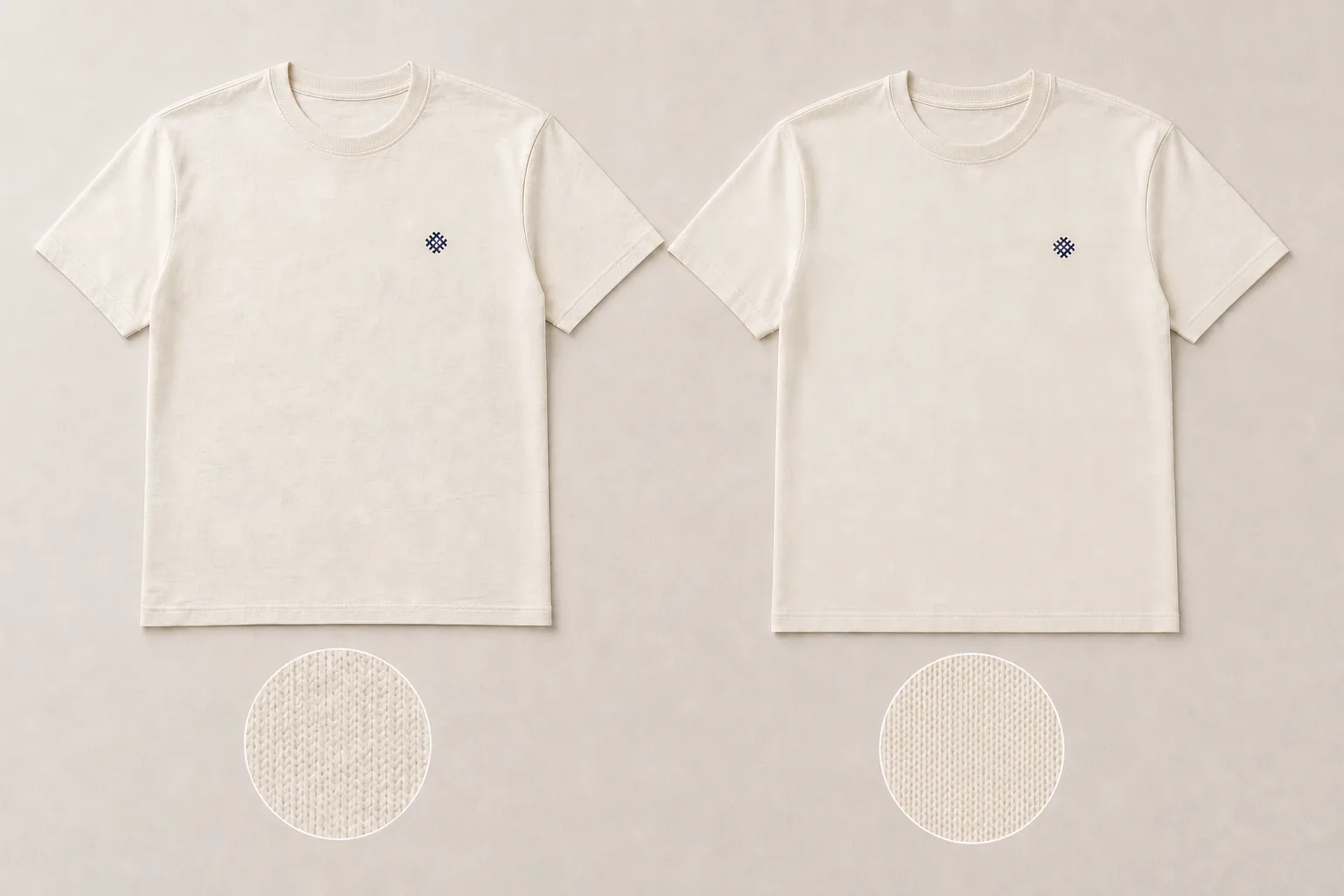
The image above keeps color, silhouette, print mark, and apparent weight constant, then uses restrained surface insets to explain the concept. It is an AI planning visualization, not microscopy and not proof that a product is carded or combed.
Why combed cotton does not automatically mean “less pilling”
Pilling is a property of the finished fabric system, not one frontmatter word. ASTM’s active D3512 pilling standard states that pilling is affected by fiber or blend, fiber dimensions, yarn and fabric construction, finishing, and refurbishing method; actual wear also varies with use and wearer.
Combing can reduce short fibers in the yarn-making stream, but an honest product claim still needs the finished fabric, finish, and care conditions. Do not accept these shortcuts without evidence:
- “combed cotton never pills”;
- “carded cotton always becomes fuzzy”;
- “ring-spun automatically means combed”;
- “higher GSM guarantees greater durability.”
If surface appearance matters, ask for a current pilling or wash result for the exact fabric—or approve a sample and care method instead of relying on the adjective.
What combing can mean for printing
A smoother, more even surface can help small edges and fine details reproduce consistently, but fiber preparation is only one part of the print system.
Before approving artwork, confirm:
- the exact garment and production color;
- the decoration method and manufacturer instructions;
- artwork dimensions, line thickness, and coverage;
- any pretreatment, underbase, blocker, adhesive, cure, or press requirements;
- stretch, seams, texture, and printable-area limits;
- the approved mockup plus a production test when the risk warrants it.
Gildan’s current Softstyle product specification, for example, lists ring-spun construction and fabric weight as separate fields. That product can be a useful reference, but its result cannot be generalized to every shirt carrying the words “ring-spun” or “combed.”
Use the fabric and print-method guide when cotton, blends, and performance polyester are all possible routes, and compare GSM as a separate specification rather than using weight as a synonym for yarn quality.
How to compare two cotton T-shirt blanks fairly
Put both choices on one sheet and keep these eight lines visible:
- Exact manufacturer and style code — not “premium tee.”
- Fiber content by production color — solid and heather colors may differ.
- Fiber preparation — carded, combed, or not stated.
- Spinning system — ring, compact ring, rotor/open-end, air-jet, or not stated.
- Fabric construction and weight — jersey/interlock plus GSM or oz·yd².
- Finish — preshrunk claims, enzyme or silicone finish, garment dye, or other treatment.
- Measurements and seams — actual width/length chart, collar, shoulder tape, hems, and tolerance.
- Evidence — sample, wash/pilling data, print test, care instructions, and approved production color.
Then compare price, availability, size range, decoration, and delivery on that same specification. There is no reliable universal “small price difference” between combed and carded shirts because the blanks may differ in several other ways at once.
When combed cotton is a strong starting point
Choose it as a starting point—not an automatic winner—when the group wants:
- a smooth natural-cotton hand;
- a cleaner surface for restrained or detailed artwork;
- an everyday tee rather than a fast-drying performance route;
- a specific approved blank whose fit, color, and sample already work.
A carded or rotor-spun shirt can still be the better choice when the group wants a particular substantial texture, vintage hand, price point, availability, or fit and the exact sample passes the required checks. The heavyweight T-shirt route is one place to compare that denser feel on an exact garment.
How Togethread handles the choice
Togethread’s coordinated minimum is 50 pieces. We compare the selected garment—not the word “combed” in isolation—with the group’s climate, fit, size range, artwork, decoration, budget, and delivery plan. The written quote confirms the exact available blank or specification, production color, sizes, decoration dimensions and locations, destination, freight, duty/tax scope, and exceptions.
A real designer reviews the brief and confirms the free first-mockup timing in writing. You approve the garment direction, artwork, and written price before production and review finished-order photos before the balance.
FAQ
Is combed cotton the same as ring-spun cotton? No. Combing prepares fiber before spinning; ring spinning is one method of turning prepared fiber into yarn. A yarn can be described by both terms, but one does not prove the other.
Is combed cotton always softer? It tends to support a smoother, finer hand in a controlled comparison. The final shirt also reflects staple quality, yarn count and twist, spinning, knit, weight, finishing, dyeing, and laundering.
Does combed cotton always last longer or pill less? No universal result follows from the label alone. Ask for evidence from the exact finished fabric because pilling and durability involve fiber, yarn, fabric construction, finish, care, and use.
Is combed cotton worth more for a bulk order? Only when the specific blank’s hand, fit, print result, size range, availability, and tested performance justify the complete delivered price. Compare same-spec samples rather than a generic premium.
Can I identify combed cotton from a product photo? Not reliably. A photo can show silhouette and broad surface appearance, but it cannot verify fiber preparation, yarn system, GSM, finish, or test performance.