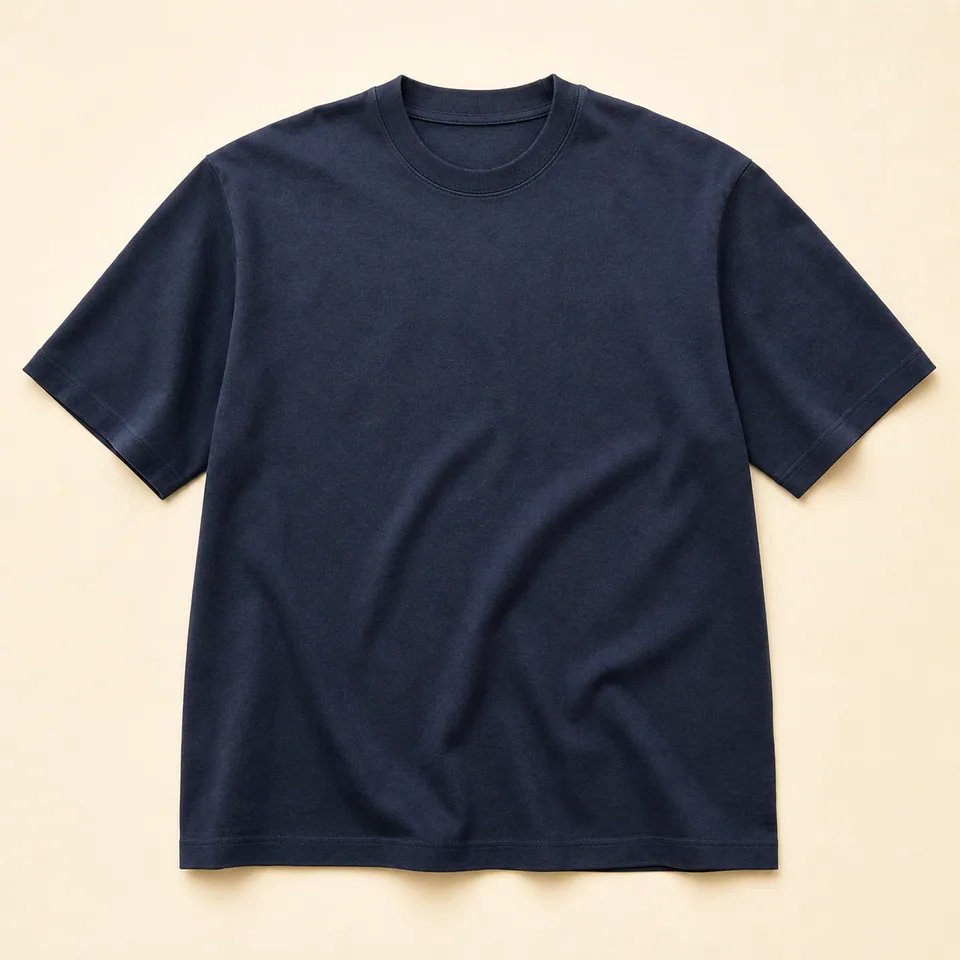
Choose a T-shirt weight
FREE GSM WEIGHT CHOOSER
How heavy should the shirt feel?
Choose the main use, then move one GSM control. The result explains the likely feel and what to verify—without treating a marketing label as a production standard.
200 GSM is about 5.9 oz/yd². Compare the number and complete garment specification, not the label alone.
Use context: everyday group wear. Compare the selected weight with climate, fit, knit, opacity, and a decorated sample.
GSM measures fabric mass per area—not total shirt weight and not quality. Threshold labels vary by brand. Compare GSM only alongside fiber, yarn, knit, finish, construction, fit, and the decorated result.
Short answer: GSM is the mass of fabric per square meter. It is useful for comparing fabric weight, but it does not establish quality, total shirt weight, breathability, fit, opacity, or durability by itself. Compare the number with fiber, yarn, knit, finish, construction, color, size chart, and a decorated sample.
The chooser above keeps the decision simple: choose the main use, move one GSM control, and copy a garment brief. It provides context, not a universal recommendation.
This page compares T-shirt fabrics from 130–280 GSM. Hoodie and fleece construction uses a different garment context; use the bulk hoodie cost and specification guide before applying any T-shirt band to a pullover or crewneck quote.
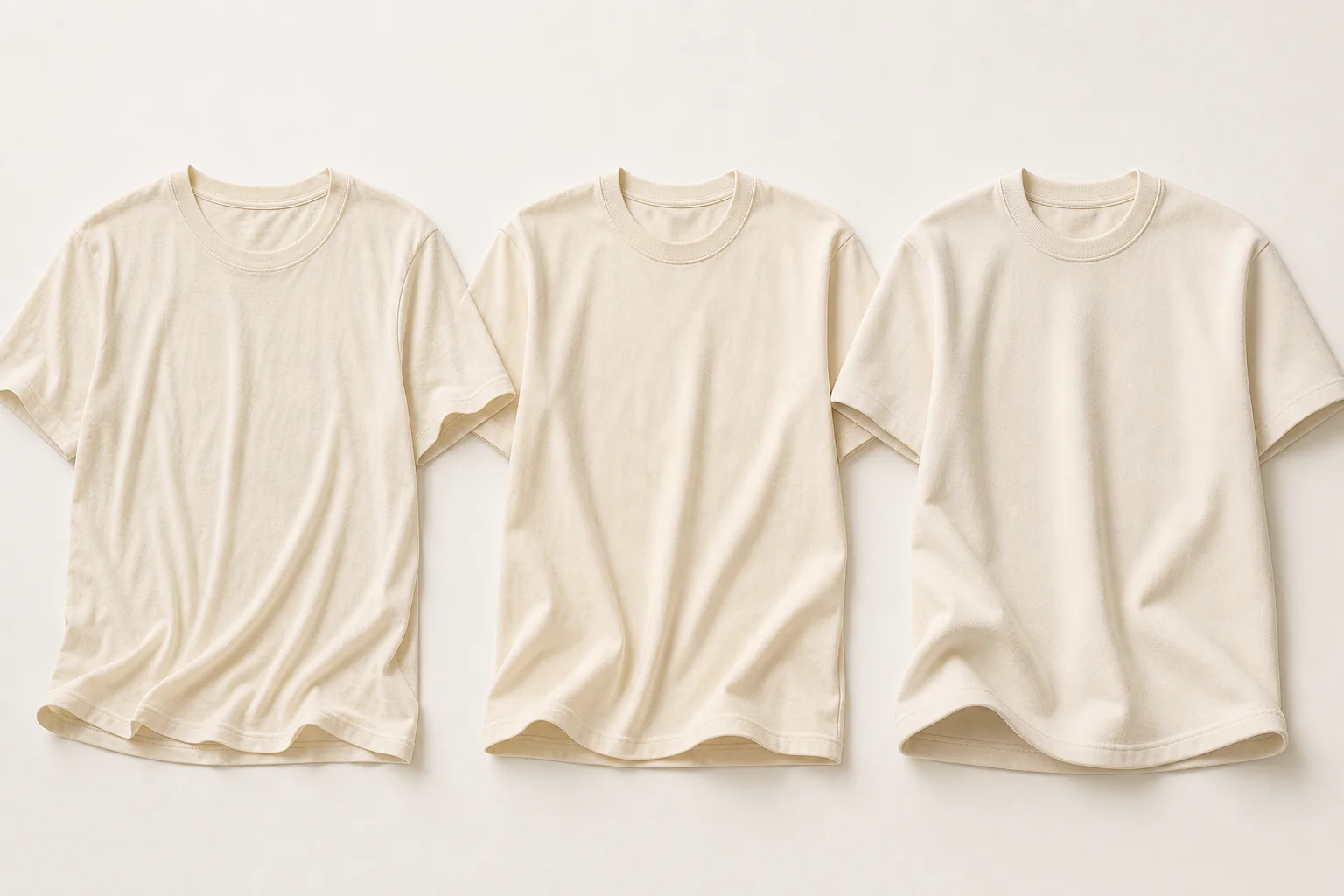
What the three-shirt comparison shows
The image keeps color, silhouette, lighting, and scale consistent so the garments—not a cropped model—remain the focus:
- Left: a lighter, more fluid visual drape.
- Center: a balanced everyday body.
- Right: a denser, more structured visual result.
Weight differences can be subtle in a photograph. Two fabrics with identical GSM may still hang differently because of fiber, yarn, knit, finishing, color, and pattern shape.
What GSM actually measures
GSM means grams per square meter. ASTM D3776/D3776M defines test methods for fabric mass per unit area. In plain language, a one-square-meter sample of 200 GSM fabric has a mass of about 200 grams under the applicable test conditions.
GSM does not mean the finished shirt weighs that amount. A shirt uses different fabric area by size and cut, and also includes collar rib, thread, labels, and other components.
To convert to the ounces-per-square-yard unit often used in US catalogs:
oz/yd² ≈ GSM ÷ 33.9
| GSM | Approx. oz/yd² | Informal comparison band used here |
|---|---|---|
| 150 | 4.4 | Lighter |
| 180 | 5.3 | Everyday |
| 200 | 5.9 | Heavier |
| 220 | 6.5 | Heavier |
| 250 | 7.4 | Extra-heavy |
These bands are navigation aids, not regulated categories.
Why “lightweight,” “midweight,” and “heavyweight” vary
Suppliers do not use one universal naming threshold. Current product examples make that visible:
- Gildan Heavy Cotton G5000 is listed at 5.3 oz/yd²—about 180 GSM—while “Heavy Cotton” is the product family name.
- AS Colour’s current tee comparison describes its 180 GSM Staple as midweight, its 220 GSM Classic as heavyweight, and its 280 GSM Heavy as an oversized, weightier option.
- AS Colour’s 220 GSM Classic Tee specification also separates fabric weight from fit, yarn, fiber content, seams, and pre-shrink treatment.
The practical rule is simple: record the actual GSM and full garment specification. Do not approve a bulk order from the marketing label alone.
A neutral way to compare 130–280 GSM
The following bands describe increasing fabric mass; they do not rank quality or prescribe a use.
130–159 GSM: lighter market range
Expect less fabric mass per area. Depending on the exact knit and fiber, the result may look more fluid. For pale colors, request an opacity photo or sample. For active use, verify fiber, knit, moisture behavior, and airflow rather than assuming a lower GSM number is automatically cooler.
160–199 GSM: everyday market range
Many familiar promotional and retail-style tees sit around this part of the market, but the same number can feel different across blanks. Compare surface smoothness, collar, shrinkage information, finished measurements, and print sample.
200–239 GSM: heavier market range
More fabric mass can create a more substantial hand and more visual body when other construction variables are comparable. Fit is still separate: a 220 GSM shirt can be regular, relaxed, or oversized.
240–280 GSM: extra-heavy market range
This range can support a deliberately dense merchandise look. Confirm climate, drape, collar, size grading, and audience preference; more mass does not automatically mean more comfort or longer life.
180 vs 200 vs 220 GSM
| Comparison point | 180 GSM | 200 GSM | 220 GSM |
|---|---|---|---|
| Approx. oz/yd² | 5.3 | 5.9 | 6.5 |
| Fabric mass per area | Lower | Middle | Higher |
| Informal band on this page | Everyday | Heavier | Heavier |
| Still unknown from GSM | Fiber, knit, fit, finish, opacity, construction, print | Same | Same |
There is no universal winner. Ask to compare actual blanks or samples under the same lighting and size, then record the selected style code in the approval.
Does heavier fabric print better?
Not automatically. Weight changes the substrate, but the print result also depends on surface, fiber, dye, artwork coverage, ink or transfer system, pretreatment, pressure, temperature, cure, and operator control.
- Screen printing: confirm the ink system, underbase, mesh, cure range, and test result on the exact garment.
- DTF: confirm film, powder, press settings, garment compatibility, dye migration risk, and finished hand feel.
- DTG: confirm fiber content, pretreatment, artwork coverage, cure, and wash test.
- Sublimation: confirm polyester content, garment color, coating or finish, artwork, and heat behavior.
Use the fabric chooser and print method chooser alongside GSM.
GSM is not a quality score
A useful garment brief also records:
- exact style code, color, and size range;
- GSM or oz/yd² and fiber percentages;
- yarn and knit description;
- fit and finished-garment measurements;
- shrinkage or stabilization information;
- collar, seams, and reinforcement;
- decoration method, size, and locations;
- approval sample and delivered quote scope.
A higher number cannot compensate for unstable sizing, weak seams, coarse yarn, poor finishing, or an unsuitable decoration process.
Choose by questions, not a fixed use range
For hot or active use, ask about fiber, knit, moisture behavior, airflow, and how the decorated area changes the feel. For a large event, compare the complete delivered cost and sample rather than assuming lighter always means cheaper. For everyday wear, verify fit, opacity, collar, and wash behavior. For premium merchandise, decide whether the audience actually wants a denser, more structured shirt, then compare the exact heavyweight T-shirt route.
This is why the chooser no longer gives a “good match” score or a fixed recommended band. Those shortcuts imply more certainty than GSM alone can support.
What to ask the supplier
- What is the exact style code, GSM, and fiber percentage?
- Is the yarn combed, ring-spun, open-end, or another construction?
- Is the fabric pre-shrunk or otherwise stabilized?
- Can I see the chosen color’s opacity and drape in the requested size?
- Which decoration system and settings will be used on this exact blank?
- Can the approval record include the blank, color, size chart, artwork dimensions, and locations?
- Does the delivered quote include setup, personalization, freight, duties, and likely rework?
Keep fiber preparation separate from fabric mass by using the combed-vs-regular cotton guide alongside this checklist.
How Togethread handles weight
Tell us how the shirts will be worn, the climate, desired feel, fit, and whether you have a target GSM. We will compare a garment route before production and show the artwork on the selected style in a free mockup.
A brief such as “about 200 GSM, exact fiber percentage stated, regular fit, finished size chart, left-chest print, and decorated sample” is more useful than “premium heavyweight.”
FAQ
What GSM counts as a heavyweight T-shirt? There is no regulated universal threshold. Some suppliers use heavyweight language around 180 GSM, while others use it at 220 GSM or reserve their heaviest product for 280 GSM. Compare the actual number and complete specification.
Is 180 GSM too thin for a custom shirt? The number alone cannot answer that. Review fiber, knit, color opacity, collar, construction, fit, and a decorated sample of the exact blank.
Is 200 GSM good for group shirts? It is a valid comparison point if the group wants more fabric mass than a 180 GSM option, but it is not automatically the best choice. Climate, use, fit, construction, price, and sample still decide suitability.
Does a heavyweight T-shirt always last longer? No. Durability also depends on yarn, knit stability, collar recovery, seams, finishing, decoration, curing, care, and use.
Does a heavyweight tee feel too hot? It can feel denser, but GSM alone does not measure thermal comfort or breathability. Compare fiber, knit, airflow, fit, color, decoration coverage, and a sample in the expected conditions.