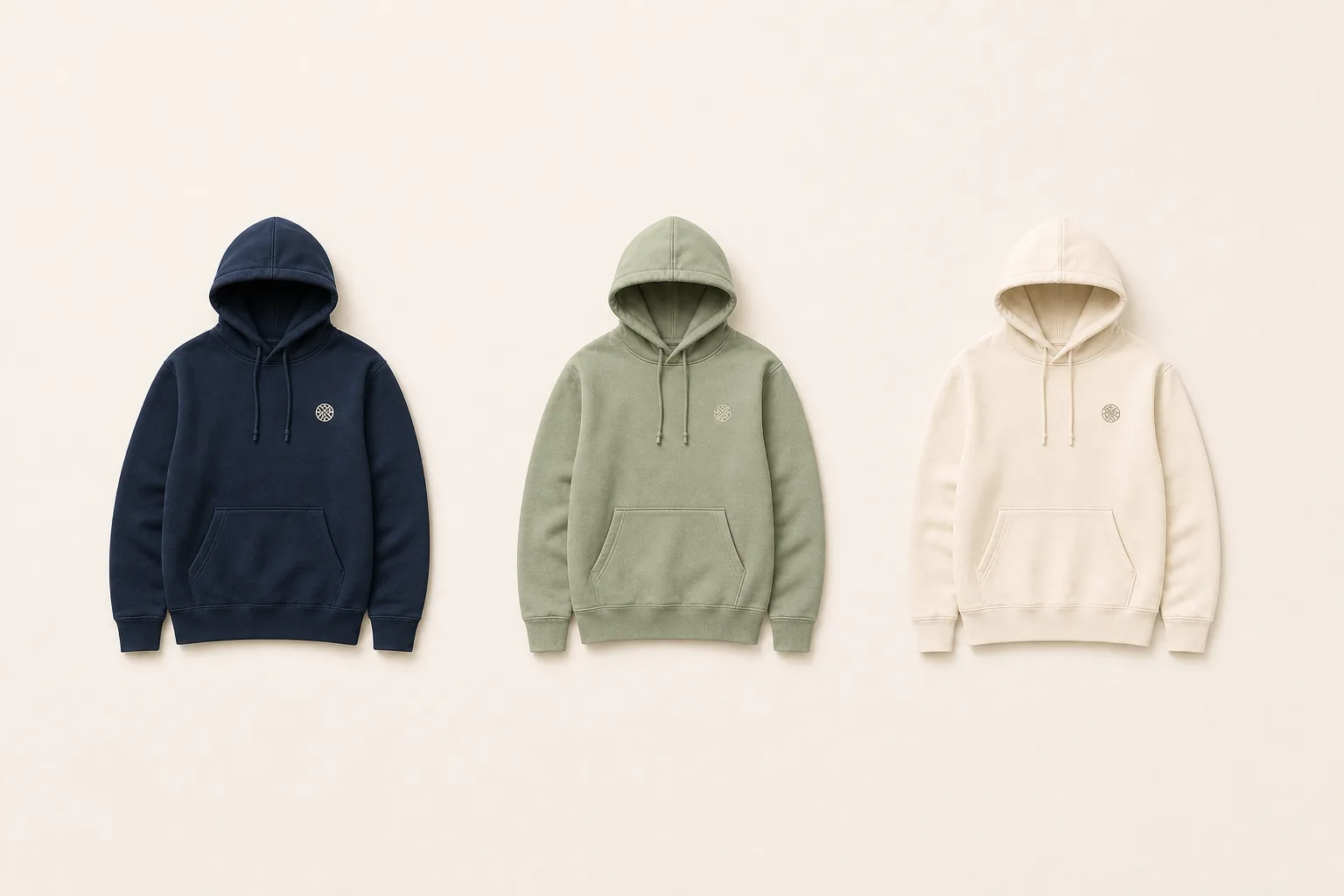
Short answer: For Togethread’s standard 50+ coordinated route, about $22–38 per hoodie is a planning range for a basic-to-substantial pullover with one standard decoration location under the written delivery scope. It is not a universal market average or a price cap. Premium or brand-specific blanks, heavier construction, larger or denser artwork, a second location, names, extended sizes, split delivery, and other exceptions can cost more.
The three complete hoodies above show visual planning directions—not verified GSM samples. A lighter everyday route, balanced midweight route, and substantial heavyweight route can look different, but the written fabric weight, composition, inside finish, construction, size chart, and sample are authoritative.
Use the complete delivered-cost formula
Compare suppliers with the same equation:
delivered unit cost = (hoodie garments + decoration + artwork/setup + personalization + confirmed delivery charges) ÷ ordered quantity
The written total should name the destination and state the freight, duty and tax scope. A blank-and-print price is not comparable with an all-in delivered price if digitizing, extra locations, names, packing, or shipping appears later.
Use the hidden custom-apparel cost checklist to keep setup, larger sizes, extra placements, rush handling, delivery, duties, and artwork preparation inside the same comparison.
What changes the price of a custom hoodie?
| Cost driver | Lower-complexity route | What can raise the quote |
|---|---|---|
| Hoodie garment | Basic pullover, standard color, available stock | Premium brand, heavier fleece, garment dye, custom panels, full zip, or limited stock |
| Fabric specification | Moderate weight and standard blend | Denser GSM/oz, cotton-rich face, specialty finish, double-layer hood, or upgraded rib |
| Decoration | One compact chest or standard front print | Larger coverage, printed back, sleeves, dense embroidery, special thread, names, or numbers |
| Quantity | More pieces using one confirmed specification | Small color/style splits that lose the same quantity efficiency |
| Size plan | Named recipients using one size chart | Youth, extended sizes, multiple fits, garment changes, or guessed replacements |
| Delivery | One destination and approved standard schedule | Split addresses, special packing, shorter eligible timing, or expanded import/delivery scope |
Quantity helps only when the compared quote keeps the same garment, fabric, artwork dimensions, locations, size range, destination, and schedule. Adding unused hoodies solely to reach a lower unit price can increase the group’s real spend and inventory risk.
When a supplier offers nearby tiers, enter the written totals in the bulk quantity-discount calculator and give every added hoodie a named recipient or purpose before increasing the order.
Choose the hoodie route before comparing price
| Planning route | Best starting use | Confirm in writing |
|---|---|---|
| Everyday fleece | Event staff, fundraisers, mild-weather groups, or cost-sensitive programs | Actual GSM/oz, fiber blend, inside finish, opacity, and shrinkage guidance |
| Balanced midweight | Schools, teams, company apparel, and repeat casual wear | Cotton-face content, rib recovery, hood construction, fit, and decoration compatibility |
| Substantial heavyweight | Premium gifts, colder conditions, retail-feel programs, or structured streetwear | Exact weight, bulk, packing volume, wash care, sample feel, and added garment cost |
“Lightweight,” “midweight,” and “heavyweight” are marketing categories, not universal standards. Compare actual GSM or oz/yd² on the same basis, then check composition and construction. A higher number may feel more substantial, but it can also become warmer, stiffer, bulkier, and more expensive than the group needs.
The GSM guide explains what fabric mass can and cannot prove; do not reuse its T-shirt comparison bands as universal fleece categories.
Custom Ink’s current hoodie guide similarly separates budget, mid-range, and premium products and says style, brand, quantity, and decoration method change its current per-piece prices. That public range is broader than Togethread’s standard planning route, which is why supplier totals should be compared on one exact specification.
Pullover, crewneck, or full zip changes the quote
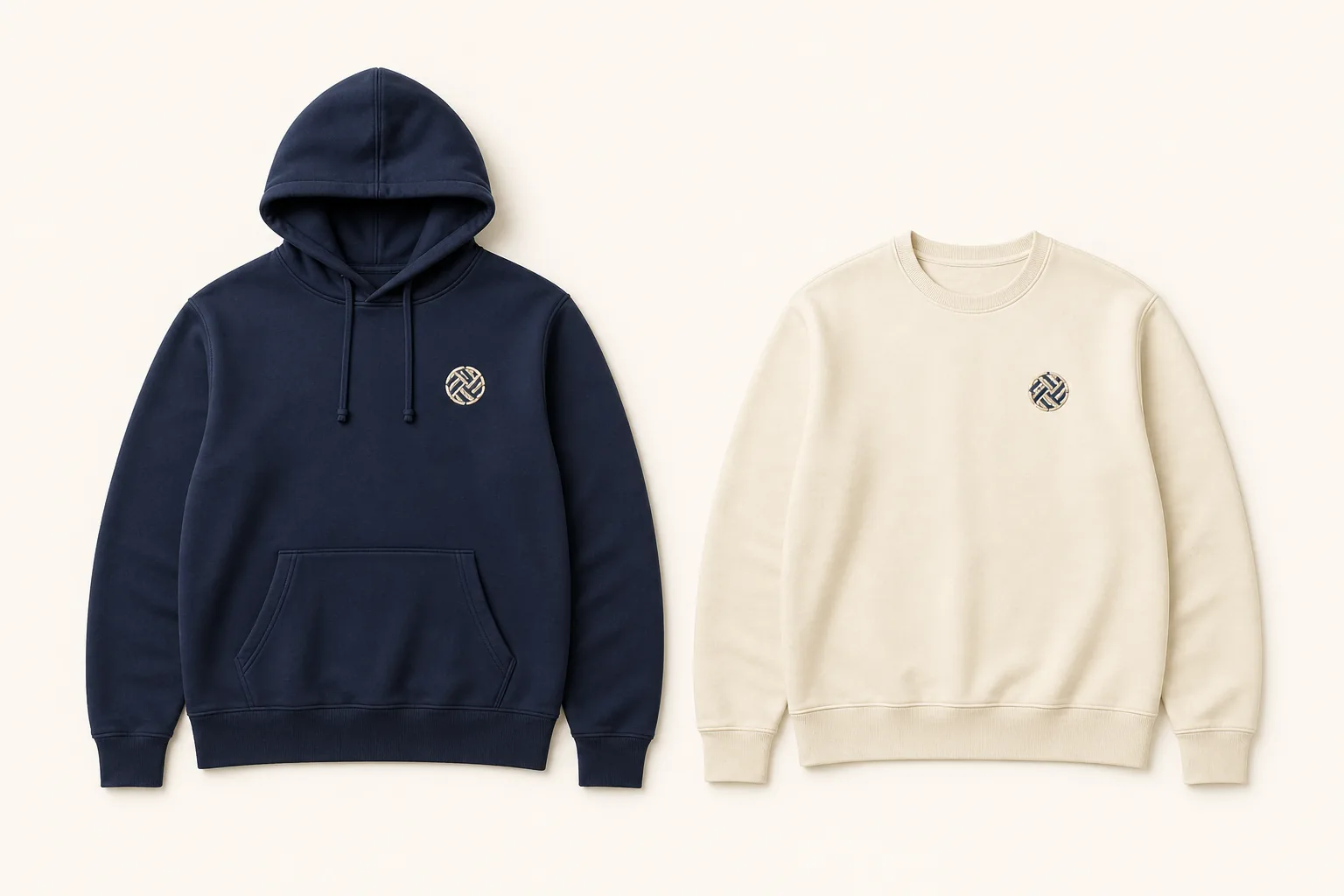
A pullover hoodie adds a hood, drawcord, and usually a kangaroo pocket. A crewneck removes those components and gives the design an uninterrupted front. A full-zip hoodie divides the front artwork area and may shift the design to the left chest or back.
Do not treat these as one interchangeable “sweatshirt” line. Use the hoodie vs crewneck comparison to choose the structure first, then request separate garment lines when the group wants more than one silhouette.
Printing and embroidery affect price differently
DTF can reproduce gradients and detailed full-color artwork without preparing a separate physical screen for every artwork color. The quote can still change with physical dimensions, coverage, location, fabric, quantity, and heat compatibility.
Screen printing can be efficient for repeat, simpler spot-color artwork at suitable volume. Screen preparation, color count, locations, ink system, fabric surface, and quantity still matter.
Embroidery suits compact logos and text when the fleece, backing, digitizing, and placement are compatible. Price follows the digitized stitch area, density, placement, garment, and quantity—not simply a thread-color count. Large solid embroidery can become heavy or stiff.
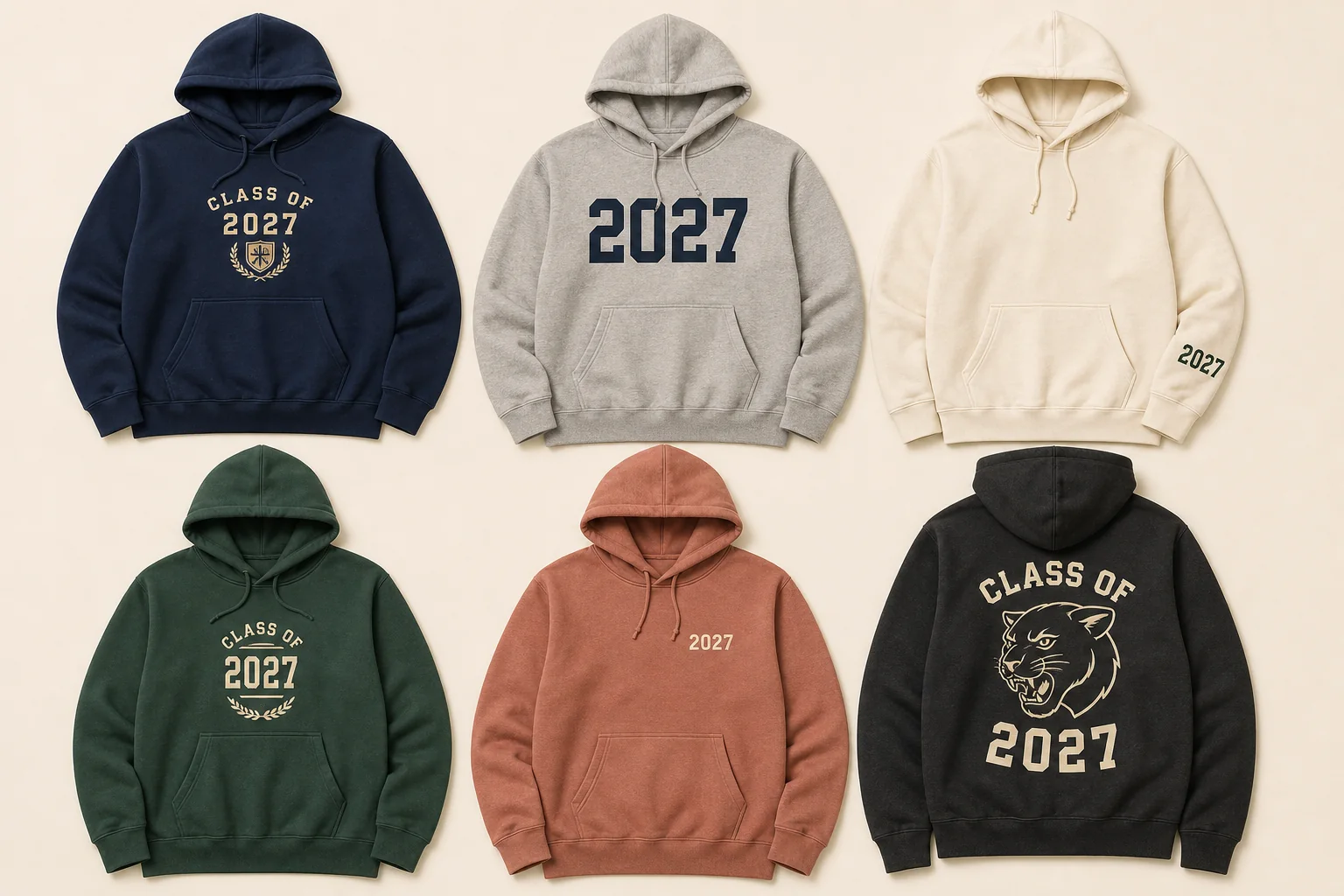
A common two-location specification is a small embroidered chest mark plus a printed back. Use the logo size and placement guide to state the intended width for each location, then quote both locations explicitly rather than assuming the back is included.
If the logo route is still open, use the two-question embroidery vs screen-printing chooser before comparing hoodie quotes.
A same-spec quote checklist
Send every supplier the same six items:
- Garment: exact hoodie or a written weight, composition, inside finish, construction, fit, and color specification.
- Quantity: total pieces plus the real color and size split.
- Artwork: the same files, physical dimensions, and location for every quote.
- Personalization: names, numbers, roles, sleeves, hood details, and second locations listed separately.
- Timing: mockup deadline, approval date, required in-hand date, and any rush assumption.
- Delivery: destination, packing, freight, duty and tax scope, and every exclusion.
Then compare the complete total and specification, not only the per-piece headline.
How Togethread quotes bulk hoodies
Togethread starts at 50 coordinated pieces. First choose the bulk hoodie or crewneck route. Mixed confirmed sizes may count toward that total, while youth, extended sizes, garment changes, multiple colors, extra placements, personalization, destination, freight, duty and tax scope, and schedule are stated in the written quote. A real designer reviews the brief and confirms the free first-mockup timing in writing. Approve the garment, artwork, dimensions, locations, quote, and delivery plan before production; review finished-order photos before the balance.
Start about 5–6 weeks before the event so the group can choose the garment, collect named sizes, review the proof, and preserve a responsible delivery plan.
FAQ
Is $22–38 the price of every custom hoodie? No. It is a Togethread planning range for a standard coordinated 50+ pullover route with one standard decoration location and a stated delivery scope. Exact garment, artwork, sizes, locations, personalization, destination, and timing determine the quote.
Does higher GSM always mean a better hoodie? No. GSM describes fabric mass per area, not fit, fiber quality, construction, shrinkage, comfort, or suitability for the climate. Use the full specification and sample when available.
Is embroidery always more expensive than printing? Not automatically. A compact embroidered mark and a large printed back follow different cost models. Compare the same garment, artwork size, placement, quantity, and delivered scope.
Does ordering more always reduce the total? Unit cost may improve when the specification stays the same, but total spend rises as pieces are added. Order quantities should come from named recipients or a defined use, not a discount tier alone.