Short answer: Choose a pullover hoodie when the group wants a hood, hand pocket, and casual outer layer. Choose a crewneck sweatshirt when an uninterrupted front, easier layering, and a cleaner uniform-ready shape matter more. Neither style is automatically warmer, heavier, better quality, or cheaper: compare the exact fabric, weight, lining, fit, construction, decoration, and size chart.
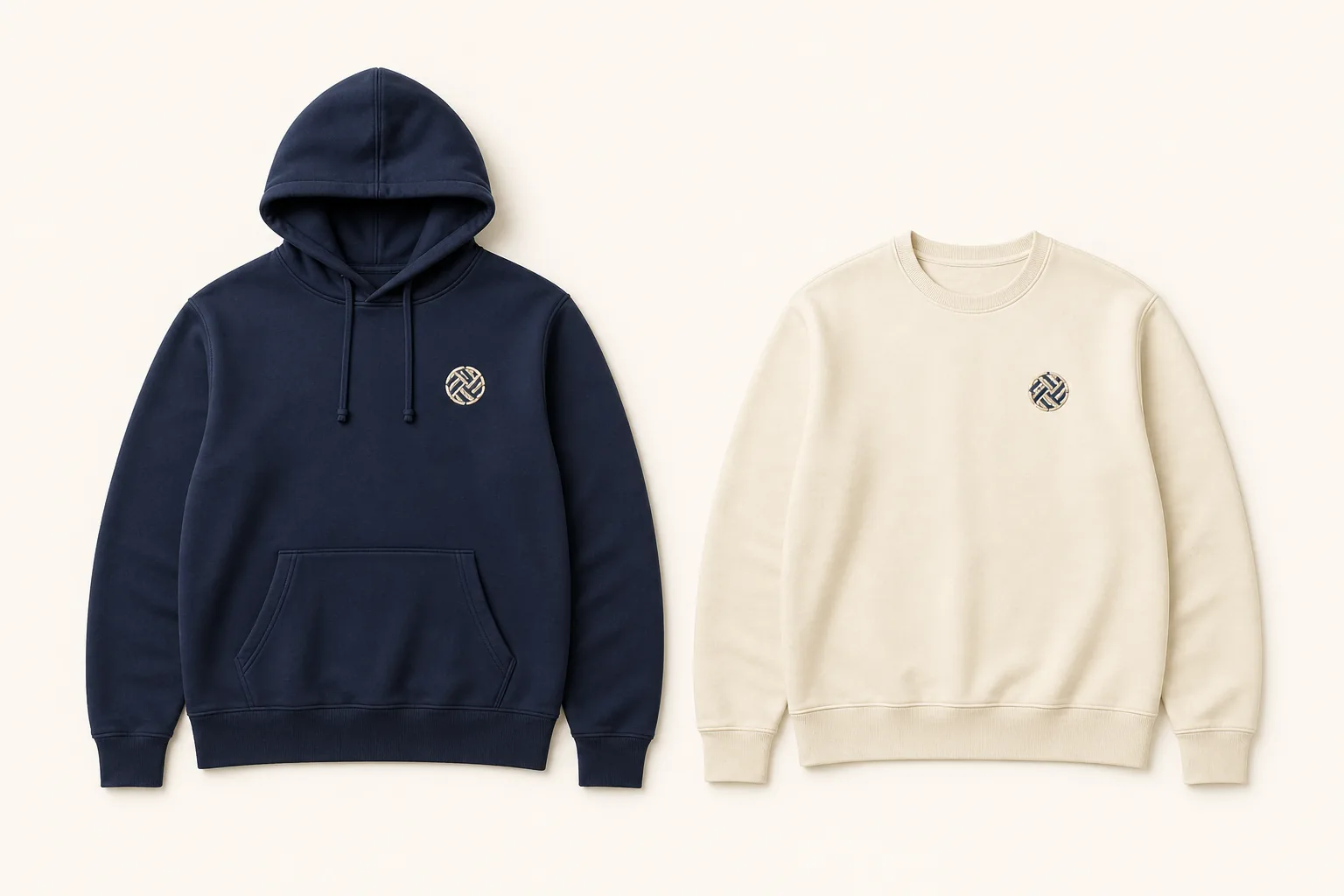
The two complete garments above isolate the silhouette difference. The hoodie adds a hood, drawcord, and kangaroo pocket; the crewneck keeps a round ribbed neckline and a continuous front panel.
Hoodie vs crewneck at a glance
| Decision | Pullover hoodie | Crewneck sweatshirt |
|---|---|---|
| Defining construction | Hood, usually drawcord and kangaroo pocket | Round ribbed neck, no hood or front pocket |
| Front artwork | Large upper-front area; pocket sets the lower boundary | Continuous panel from neckline toward the ribbed hem |
| Back artwork | Hood can cover the highest part when worn down | Upper back stays visible |
| Layering | Useful as an outer casual layer; hood adds bulk under a coat | Sits more cleanly under jackets, uniforms, or event layers |
| Storage and coverage | Hand pocket plus head and neck coverage | No pocket or hood; simpler silhouette |
| Visual tone | Casual, athletic, school, team, or weekend | Classic, polished, retro, staff, or gift-ready |
This comparison is for a pullover hoodie. A full-zip hoodie is a different artwork problem because the zipper divides the front; left-chest and back placements often become more practical than one large centered print.
Warmth and quality come from the specification
A hood adds optional coverage around the head and neck, but it does not prove that the whole garment is warmer. A dense, brushed heavyweight crewneck can feel warmer than a lightweight hoodie. Compare:
- Fabric weight: use the same GSM or oz/yd² basis when possible.
- Fiber composition: cotton, polyester, and blends differ in feel, care, shrinkage, and drying behavior.
- Inside finish: brushed fleece, loopback/French terry, and unbrushed interiors do not feel the same.
- Fit and construction: body volume, rib recovery, seam structure, hood layers, and pocket construction affect comfort and durability.
- Actual sample or product data: do not use “hoodie” or “crewneck” as a quality grade.
The exact selected garment matters more than a broad 320–400 GSM category. A higher number can feel more substantial, but it can also become warmer, stiffer, bulkier, and more expensive than the group needs.
Which gives your design more usable space?
For a centered front design, a crewneck provides the least interrupted panel. On a pullover hoodie, keep artwork above the pocket and confirm the real printable dimensions for the selected size range. A small left-chest mark can work on either style, while back artwork on a hoodie should be reviewed with the hood both up and down.
Use these starting points:
- Large centered front: start with a crewneck, or keep a hoodie graphic clearly above the pocket; approve physical width and height on the smallest and largest ordered sizes.
- Small left chest: either style can work; approve the distance from the neckline, pocket, and side seam.
- Full back: either style can work; review a hoodie with the hood both up and down.
- Embroidery or sleeve detail: approve the actual stitch field, backing, sleeve taper, cuff clearance, and left/right orientation on the selected fleece.
Custom Ink’s current sweatshirt guide also separates style, fabric weight, fit, and decoration rather than treating every sweatshirt as the same product.
Do not guess the size from the style name
There is no universal rule that a hoodie runs larger or that a crewneck should be sized up. Regular, relaxed, oversized, and fitted garments can exist in either silhouette. Adidas’ current sweatshirt guidance likewise says there is no single size-up or size-down rule and directs buyers to the specific product size guide.
Lock the exact garment first, then collect named sizes using its body-width and body-length measurements. If the group mixes hoodies and crewnecks, record each person’s garment + color + size on one roster; do not assume the same letter size measures the same across both products.
Which style fits your group?
Choose a pullover hoodie when the hood and pocket have a real use, the garment will serve as casual outerwear or travel gear, and the artwork fits clearly above the pocket or on the back. Confirm that the extra bulk still works for packing and layering.
Choose a crewneck sweatshirt when a continuous front or visible upper back matters, the garment needs to sit under a jacket or uniform, or the group wants a simpler staff, company, reunion, or gift silhouette.
BlueCotton’s 2026 comparison reaches a similar use-based distinction: crewnecks are easier to layer, while hoodies add coverage and a pocket. Treat that as a silhouette guide, then compare the exact product specification.
If preferences are genuinely split, quote both as separate garment lines using the same artwork and delivery scope. Confirm whether the combined quantity counts toward the minimum and approve one mockup for each silhouette.
Compare cost without changing the specification
A hoodie often uses more components because of the hood, pocket, and drawcord, but style name alone does not set the final price. Compare the same fabric weight, composition, color, size range, artwork dimensions, decoration method, locations, personalization, quantity, and destination.
Use the bulk custom hoodie cost guide to compare a dated planning range with the same specification and delivered scope; do not compare a lightweight blank with a heavyweight finished crewneck.
For Togethread’s 50+ coordinated route, both silhouettes can be quoted when stock and the combined specification support them. Youth, extended sizes, garment changes, multiple colors, extra placements, names, destination, freight, duty and tax scope, and schedule are confirmed in writing. A real designer confirms the free first-mockup timing in writing after reviewing the brief; approve the exact garment and proof before production and review finished-order photos before the balance.
A four-step decision
- Name the use: outdoor layer, school spirit, staff uniform, gift, travel, or event day.
- Lock the specification: fabric weight, composition, inside finish, fit, color, and size range.
- Place the artwork: approve physical dimensions around the neckline, pocket, hood, seams, and cuffs.
- Compare the written totals: keep quantity, personalization, destination, and required date the same.
FAQ
Is a hoodie always warmer than a crewneck? No. The hood adds optional head and neck coverage, but fabric weight, inside finish, fit, and construction determine the garment’s overall warmth. Compare exact products.
Which is better for a large front design? A crewneck offers the cleanest uninterrupted panel. A pullover hoodie can still carry a large front design when it fits above the kangaroo pocket and the physical print area is approved.
Are crewnecks always cheaper than hoodies? Not necessarily. A basic crewneck may cost less than a comparable hoodie, but a premium heavyweight crewneck can cost more than a lighter hoodie. Compare the same specification and delivered scope.
Can one group order both? Possibly. Record each person’s garment and size separately, confirm whether the combined quantity qualifies, and approve a mockup and quoted line for each silhouette.