Choose a T-shirt fabric in two questions
FREE FABRIC CHOOSER
Cotton, polyester, or a blend?
Pick what matters for the people wearing the shirts. The result is a practical starting point—not a substitute for checking the exact garment and print method.
Best matched to everyday wear and a soft natural hand.
Check before approval: Cotton absorbs moisture and dries more slowly than performance polyester. Confirm shrinkage guidance and care.
Fabric percentages are not the whole story. Also compare GSM, yarn quality, knit, finish, fit, color, and a decorated sample or close-up before approving a bulk order.
Short answer: Start with a cotton-rich everyday tee when a natural hand matters, performance polyester for active use or full sublimation, and a cotton/poly blend when the group wants a balance of feel, drying, shape retention, and care. Then compare the exact blank, because fiber percentage alone does not determine the finished shirt or print result.
There is no single best T-shirt fabric for every order. The strongest choice matches how the shirt will be worn, the exact decoration method, the desired feel, and the level of care the group will realistically give it.
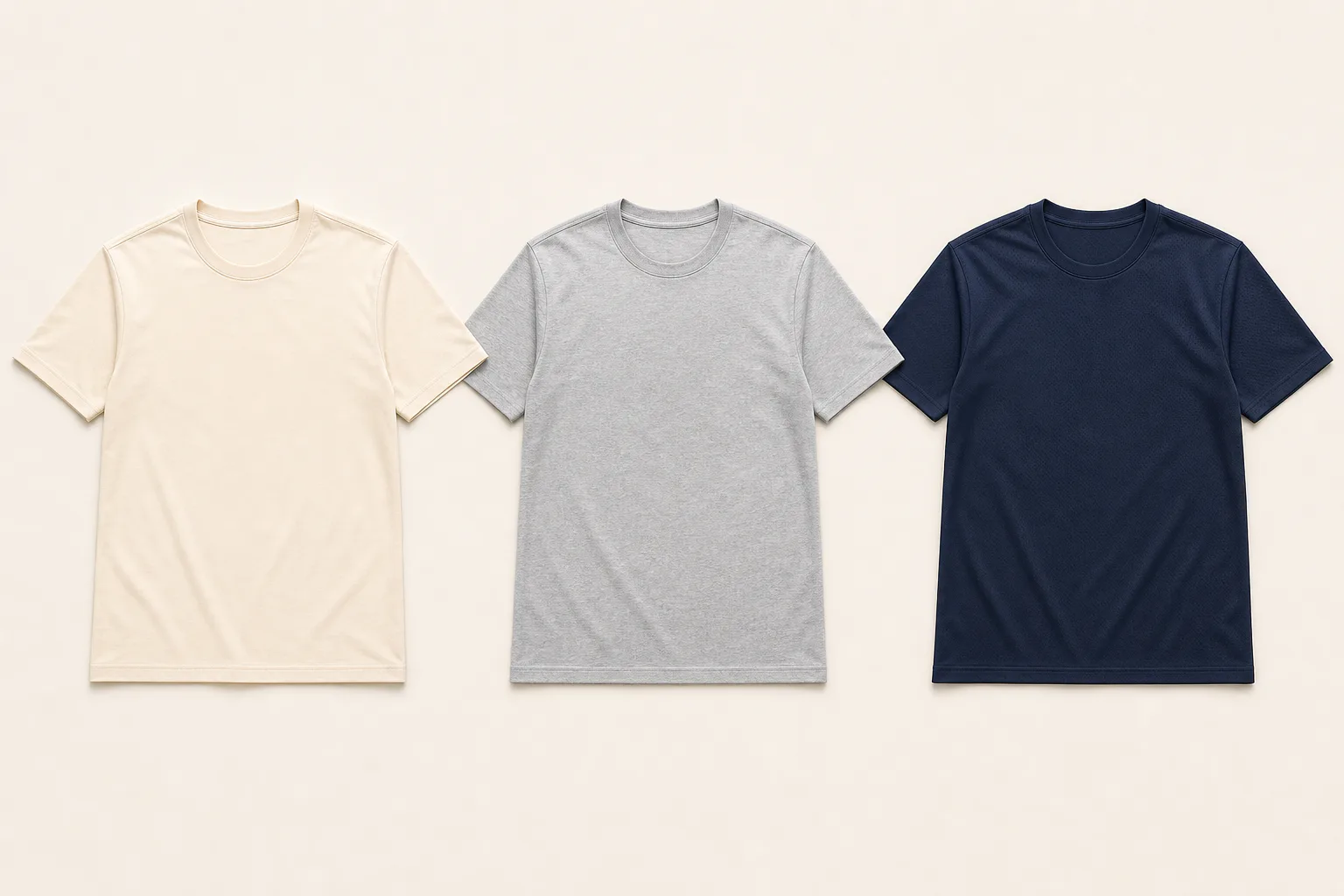
What the fabric comparison image shows
The image above keeps the garment shape, scale, lighting, and framing consistent so the three starting points are easier to compare:
- Left — cream cotton: a complete matte everyday tee.
- Center — heather cotton/poly blend: a complete tee with restrained heather texture.
- Right — navy performance polyester: a complete tee with a subtle technical micro-knit.
The image is a visual reference, not a specification sample. Two shirts with the same fiber percentage can still feel different because of fiber preparation, spinning, yarn, knit, GSM, finishing, fit, and construction.
Cotton vs polyester vs blend: quick comparison
| Decision factor | Combed cotton | Cotton/poly blend | Performance polyester |
|---|---|---|---|
| Hand feel | Soft, natural, matte | Balanced; depends on ratio | Smooth, technical |
| Sweat behavior | Absorbs moisture; slower to dry | Better drying as polyester content rises | Fastest drying of the three |
| Wrinkle and shape retention | More prone to wrinkles or shrink if untreated | Usually easier care | Strong shape retention |
| Standard front/back DTF | Strong option | Strong option | Strong option with correct process controls |
| Screen printing | Strong, familiar base | Commonly printable; exact blend matters | Possible, but dye migration and heat require controls |
| DTG | Usually strongest on cotton-rich fabric | Depends on cotton percentage and pretreatment | Often not the first choice |
| Sublimation | No | Only high-poly blends, usually with a softer result | Best on white or light, high-polyester fabric |
| Best fit | School, company, reunion, casual merch | Staff, volunteers, repeat use, general events | Teams, races, outdoor and active groups |
When combed cotton is the best choice
Choose cotton when most people will wear the shirt casually and the natural feel matters. CottonWorks explains combing as an extra fiber-preparation step that removes selected short fibers and improves alignment. In a controlled like-for-like comparison that can support a more even yarn and surface, but the label alone does not guarantee a specific hand or print result. Use the combed-vs-carded cotton comparison to separate that fiber-preparation choice from GSM, fit, finish, and construction.
Cotton is especially practical for class shirts, family reunions, company offsites, club merch, and any order where “Would I wear this again?” matters more than sweat management.
Watch-outs:
- Cotton absorbs sweat instead of moving it away quickly.
- Untreated cotton may shrink more than polyester.
- GSM does not prove quality by itself; compare yarn, knit, finish, and construction too.
When performance polyester wins
Choose polyester when the group will run, train, work outside, or wear the shirts repeatedly in heat. Its low moisture absorption helps the garment dry faster, and technical knits can improve airflow.
For a school program that may combine performance tops and athletic shorts, use the bulk PE uniform guide to keep each garment, size range, crest placement, and quantity separate while preserving one school color system.
Polyester is also the normal base for bright, traditional sublimation. Epson recommends white or light polyester fabrics; higher polyester content generally supports a more vivid result because the process does not add an opaque white ink layer. Use the dye sublimation guide to compare transfer paper, fabric color, panel artwork, DTF, and screen printing before choosing the method.
For an active group comparing actual garments, use the bulk performance-shirt route to keep fiber, knit, color, print system, sizes, and quantity in one specification.
Watch-outs:
- High heat can reactivate garment dyes and cause dye migration, especially when light ink is applied to dark polyester.
- The printer needs the correct ink, barrier, transfer, and curing settings for the specific garment.
- “Performance polyester” is not one fabric; mesh size, stretch, weight, and finish change the feel substantially.
When a cotton/poly blend is the safer middle ground
A blend can be the most practical answer for staff shirts, volunteer teams, recurring events, and mixed-use groups. Cotton contributes a more familiar hand; polyester improves shape retention, drying, and wrinkle resistance.
Do not treat every blend as the same garment. A cotton-rich 60/40 shirt behaves differently from a 50/50 utility tee or a lightweight tri-blend. Ask for the exact percentage and a close-up or physical sample when the hand feel is important.
Blends are also useful when different people prioritize different things. They rarely maximize cotton softness or polyester performance, but they can reduce the compromises that would bother the group most.
Match the print method to the fabric
DTF: versatile across cotton, polyester, and many blends. The fabric and cure settings still matter, particularly on dark polyester; the five-stage DTF workflow shows where garment testing, curing, and pressing enter the process.
Screen printing: works across many fabrics, with cotton and cotton-rich blends providing a familiar base. Polyester may need low-cure ink or dye-blocking controls.
DTG: usually starts with cotton-rich garments. Brother identifies open, porous fibers such as 100% cotton as ideal and notes that blends and polyester require specific pretreatment, curing, and testing.
Sublimation: requires white or light, high-polyester fabric for a bright result. It is not the right process for a classic dark cotton tee.
Use the print method chooser if the decoration decision is still open.
Fabric weight matters—but GSM is not a quality score
GSM means grams per square meter. It tells you how heavy the fabric is, not whether the yarn, stitching, cut, or finish is good.
- Around 150–180 GSM: lighter and cooler; useful for budget or hot-weather tees.
- Around 190–220 GSM: more substantial, structured everyday feel.
- Above 230 GSM: intentionally heavy; useful when a streetwear or premium merchandise feel is the goal.
A well-made 180 GSM combed-cotton tee can feel better than a coarse 220 GSM tee. Use the GSM guide to compare weight separately from fiber content.
Six questions to ask before approving the garment
- What are the exact fiber percentages?
- What is the GSM, knit, and yarn type?
- Is the garment pre-shrunk or stabilized?
- Which print method and cure settings will be used on this exact fabric?
- Can I see a close-up or decorated sample in the chosen shirt color?
- Does the size chart describe finished garment measurements or body measurements?
These questions reveal more than “Is it cotton or polyester?” alone.
Sources and evidence boundaries
- CottonWorks: fiber preparation for spinning — what combing changes before spinning.
- Brother GTX support: printable garment types — cotton, blends, polyester, pretreatment, and test-print boundaries for DTG.
- Epson: sublimation fabrics — why white or light polyester is the normal sublimation starting point.
- ScreenPrinting.com: printing polyester and blends — dye migration, barrier bases, ink choice, curing controls, and testing.
These sources describe processes and starting conditions, not a universal ranking of finished garments. Approve the exact blank, color, decoration recipe, size chart, and decorated sample or close-up for the order you are buying.
If repeated washing matters, use the print durability guide to compare failure signs and the evidence to request for the exact fabric and decoration system.
How Togethread helps you choose
Tell us the occasion, climate, how often the shirts will be worn, and what kind of design you want. A designer will recommend a fabric and decoration route before production. You will see the design on the selected garment in a free mockup, and nothing prints until you approve it.
For a bulk order, request the exact fabric percentage, GSM, and a close-up or sample reference in the quote notes. If performance and casual wear are both important, say which matters more rather than asking for a generic “best shirt.”
FAQ
What is the best T-shirt fabric for high-quality printing? For a classic everyday shirt, smooth combed cotton is a strong starting point. DTF also works on polyester and blends, while sublimation specifically needs white or light high-polyester fabric. The best result comes from matching the fabric, artwork, and print process rather than choosing fiber alone.
Is 100% cotton always better than a cotton-poly blend? No. Cotton usually feels more natural, but a blend often retains shape, dries faster, and resists wrinkles better. Choose based on actual wear conditions and ask for the exact blend ratio.
Can you print full-color artwork on polyester? Yes. DTF can produce full-color artwork on suitable polyester, and sublimation produces bright permanent color on white or light high-polyester garments. Dark polyester needs production controls to reduce dye migration.
Does a heavier GSM make the print better? Not automatically. Weight can add structure, but surface smoothness, yarn quality, knit, pretreatment, ink, curing, and artwork preparation also affect the result.
Which fabric is best for a charity 5K or sports team? Performance polyester is usually the strongest starting point because it dries faster during activity. A cotton/poly performance blend can work when the group wants a less technical feel and the event is not highly intense.