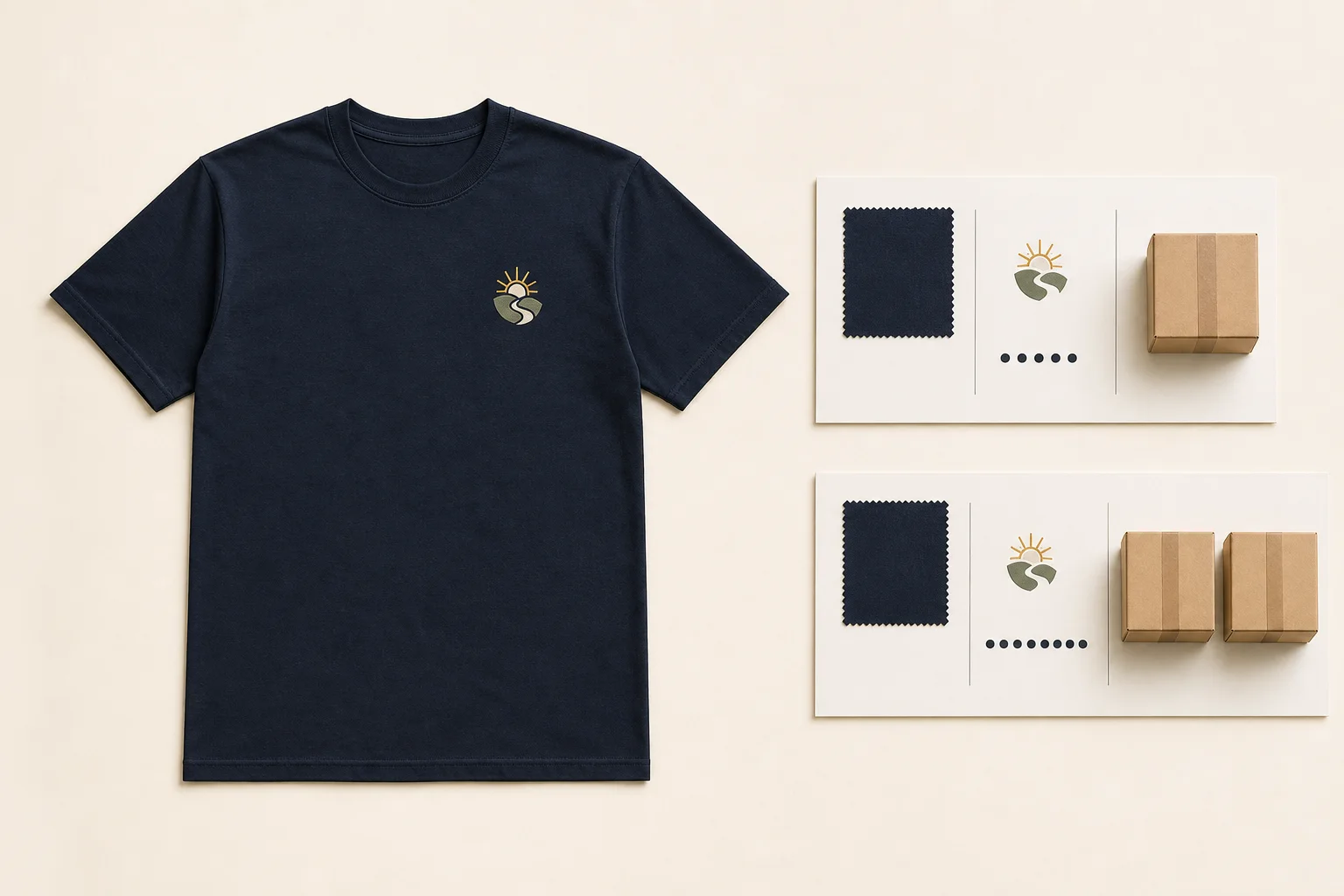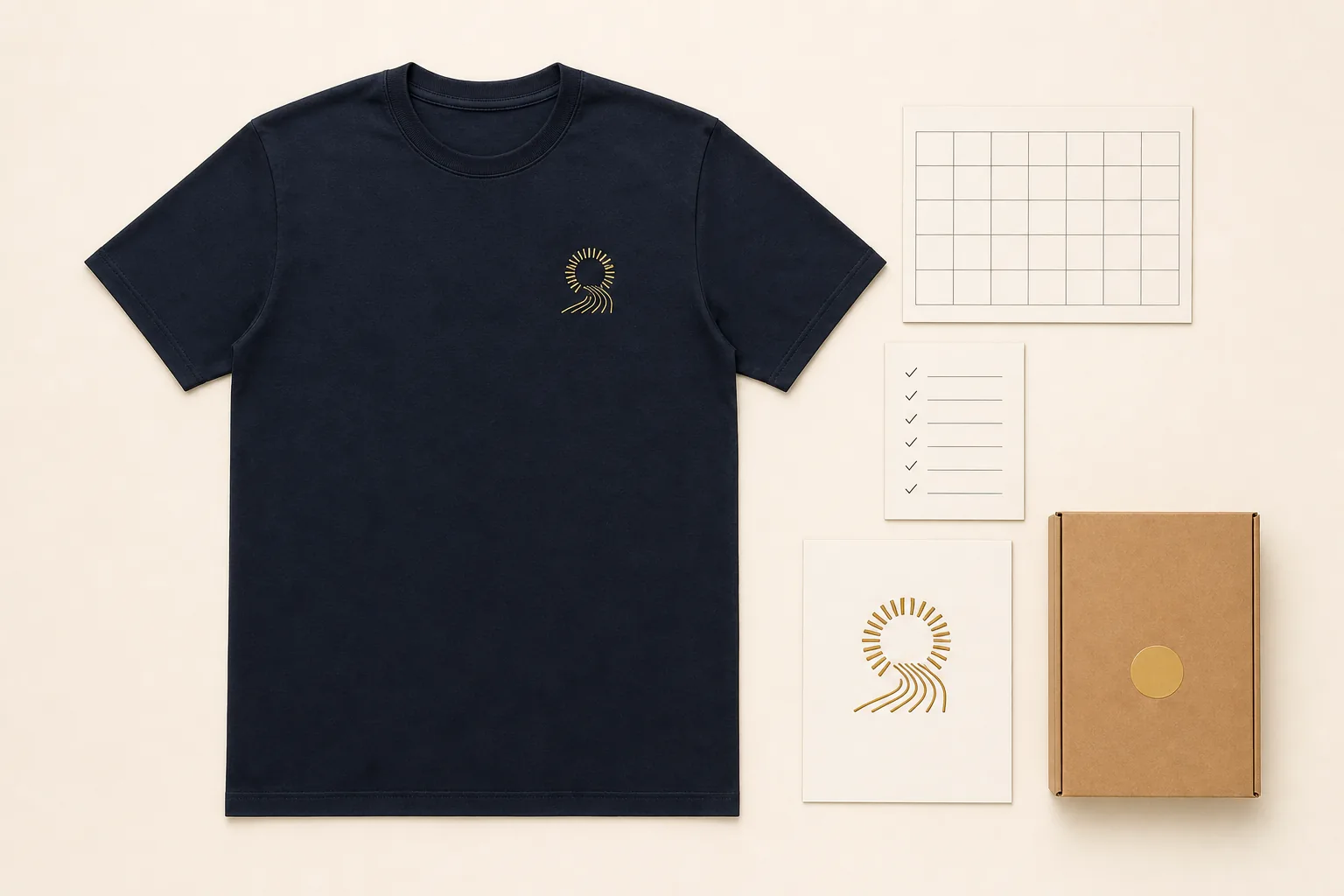
Short answer: A setup fee pays for work completed before the production run. In screen printing, that can include color separation, film output, one prepared screen per spot color, press registration, and test prints. A supplier may itemize that work or include it in the garment price. DTF does not prepare a separate physical screen for every artwork color, but artwork checks, transfer production, pressing, sampling, and order handling still have a cost. Compare the complete written total—not the setup-fee line by itself.
The two complete shirts above use the same artwork. The screen-print side separates the artwork into three prepared layers; the DTF side carries the combined design on one transfer film. That visual difference explains why the two methods can structure preparation costs differently without proving that either final quote is cheaper.
Use the bulk custom-shirt cost calculator after this comparison to place garment, decoration, quantity, and delivery inside one planning range instead of estimating the setup line in isolation.
What a setup fee can cover
“Setup” is not one universal service. Ask the supplier to list what happens before the first sellable garment. It may include:
- Cleaning or rebuilding the artwork at finished size
- Separating spot colors or preparing a white underbase
- Outputting film positives and coating, exposing, washing, and drying screens
- Registering multiple screens so the colors align
- Loading the garment and ink system, then producing test prints
- Digitizing embroidery or preparing another method-specific production file
- Creating a sample, proof, or documented approval checkpoint
The fee can be charged per screen, color, location, design, order, or job—or bundled into another line. The label alone does not show the complete amount of preparation work.
For a screen-print run, also ask how cure and test results are verified. The print durability guide explains which early failure signs point back to the garment, ink or transfer system, application, artwork coverage, or care instead of treating the method name as a quality guarantee.
Why screen-print setup follows colors and locations
ScreenPrinting.com’s current process guide explains that screen printing applies one ink color at a time, each color requires its own screen, and multicolor jobs require screen registration. A second print location usually needs its own prepared set because the artwork, platen position, dimensions, or garment area changes.
If the practical question is how one, three, or full-color artwork changes that scope, use the multi-color screen-print cost guide before asking suppliers to price the same design.
That means these are different production scopes:
| Artwork plan | Preparation question to ask |
|---|---|
| One spot color on the front | Is one screen and one location included? |
| Three spot colors on the front | Are separation, three screens, registration, and test prints included? |
| Front plus back | Is each location priced and prepared separately? |
| Dark garment with an underbase | Does the white layer require another screen or pass? |
| Reorder | Are the screens stored, remade, or replaced by a new preparation charge? |
Do not assume every visible color creates exactly one screen. Underbases, specialty inks, simulated process separations, and method-specific production choices can change the structure. Ask for the actual screen count and locations used for the quoted artwork.
What “$0 setup” really means
“$0 setup” can mean the supplier has included preparation in the item price rather than listing a separate fee. For example, Custom Ink’s current pricing page says its quotes include artwork assistance, print setup, and standard shipping, while product, ink colors, sides, and quantity still affect the price.
That is a provider-specific pricing policy—not proof that preparation takes no labor or that its complete order will cost less. Compare:
- The same exact garment and color
- The same artwork dimensions, colors, and locations
- The same quantity and real size range
- The same personalization and approval scope
- The same delivery destination and in-hand date
- The complete total, including every stated exception
A quote with a separate setup line can still be lower than a bundled quote. A bundled quote can still be clearer when it shows the final scope and total. The useful question is not “Who charges $0?” but “What complete work and delivered result does this total buy?”
When the artwork and garment stay the same but quantity changes, use the bulk quantity-break guide to compare the complete totals and useful piece counts rather than assuming that spreading a fixed preparation charge automatically creates a better order.
How DTF preparation differs
DTF builds the decoration on film, adds adhesive powder, cures the transfer, and heat-presses it to a compatible garment. It does not prepare one physical mesh screen for each artwork color. The DTF workflow guide explains the film, ink, white layer, powder, curing, pressing, and garment checks that replace that screen-based structure.
No separate color screens does not mean no preparation work. DTF pricing can still move with:
- Artwork cleanup and production-file checks
- Finished print dimensions and total ink/adhesive coverage
- Front, back, sleeve, or other locations
- White ink, fine detail, and compatible transfer requirements
- Garment fabric, color, seams, heat sensitivity, and dye migration risk
- Quantity, personalization, pressing, sorting, quality control, and delivery
Use the HTV vs screen printing vs DTF comparison when the production method is still open. Choose the route from the garment, artwork, quantity, repeatability, feel, testing, schedule, and complete quote—not from the setup line alone.
A same-spec setup-fee checklist
Send every supplier the same request:
| Confirm in writing | Why it matters |
|---|---|
| Exact garment, color, and size range | Prevents a cheaper blank from appearing to be a cheaper setup |
| Finished artwork dimensions and every location | Connects preparation to the physical job |
| Decoration method and production structure | Identifies screens, transfer preparation, digitizing, or other work |
| Itemized or bundled setup policy | Shows where preparation is priced |
| Reorder policy | Clarifies whether preparation must be repeated |
| Sample, proof, and approval checkpoints | Defines what can be reviewed before bulk production |
| Complete delivered total and exceptions | Makes different quote formats comparable |
If a supplier cannot show where preparation is included, ask for a revised written quote before comparing totals.
How Togethread handles the standard DTF route
For a suitable standard DTF order, Togethread does not list a separate physical screen charge for every artwork color. The written quote still confirms the garment, artwork dimensions, coverage, locations, quantity, size range, personalization, destination, freight, duty and tax scope, delivery plan, payment checkpoints, and exceptions.
The first-mockup timing and full approval-to-delivery schedule are confirmed in writing for the actual order. Production begins only after the mockup, roster, quote, and schedule are approved. Finished-order photos are shared before the balance is due and before dispatch. Togethread’s coordinated minimum is 50 pieces.
FAQ
How much should a screen-print setup fee be? There is no universal amount. Ask how many screens and locations are being prepared, what proof or test work is included, whether the charge is itemized or bundled, and what the complete delivered total is.
Does every screen-print color need its own screen? Spot-color screen printing generally separates colors into prepared screens, but underbases, process separations, specialty inks, and the exact artwork can change the screen count. Confirm the production separation for the real design.
Does DTF have no setup cost? DTF avoids separate physical screens for each artwork color, but it still requires artwork preparation, transfer production, pressing, compatible garments, quality control, and order handling. A supplier may include those costs in other lines.
Is a $0-setup quote automatically cheaper? No. It may bundle preparation into the item price. Compare the same garment, artwork, locations, quantity, approval scope, destination, and complete total.
Will a reorder use the same setup? It depends on the method and supplier. Screen storage, remaking, artwork changes, transfer production, garment availability, and current pricing can all change. Ask for the reorder policy in writing.