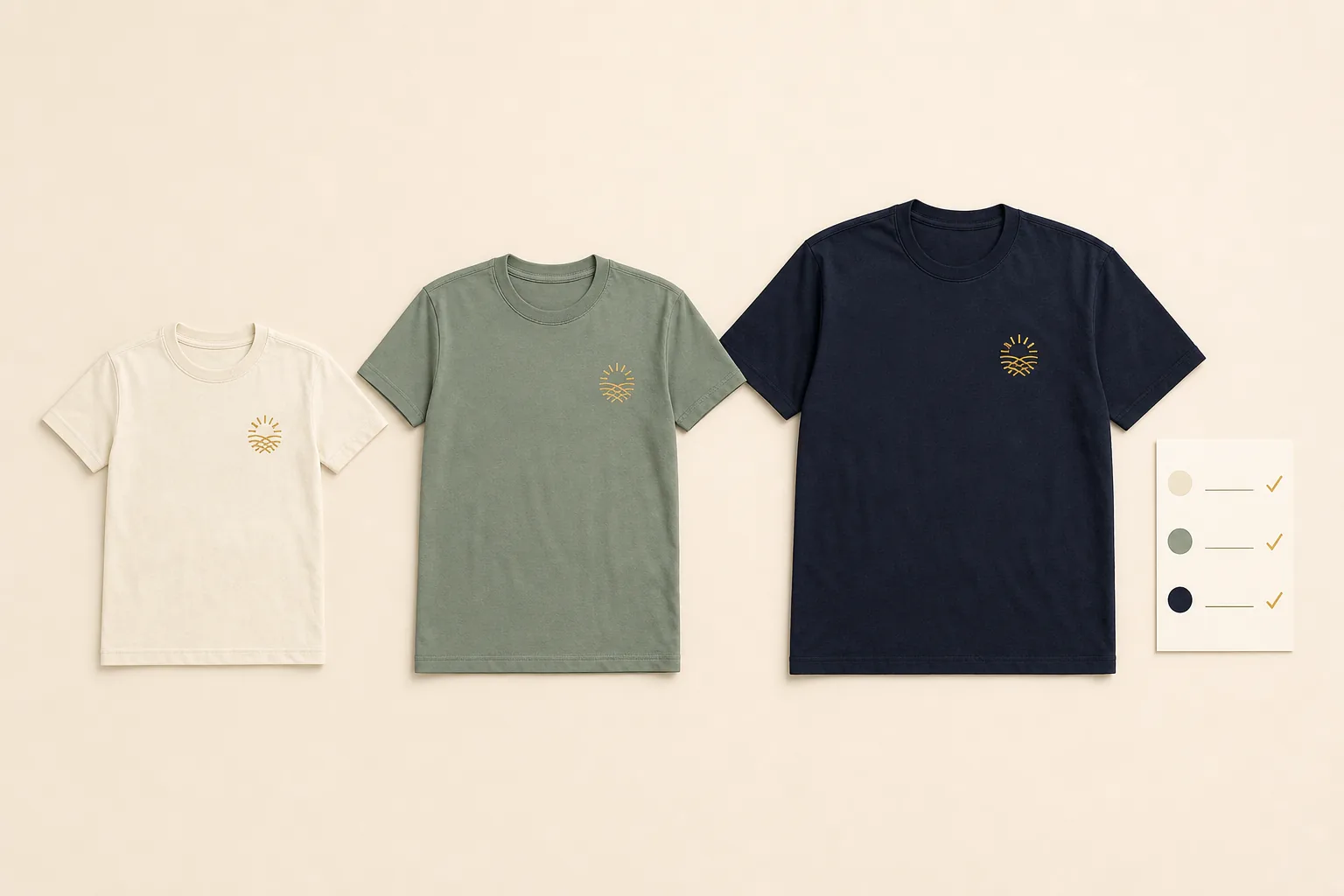
Short answer: Keep youth, adult, and extended sizes on one named roster, but choose each size from the exact selected garment’s chart. A letter such as M or XL is not a universal measurement, and the written quote should identify every supported size and any garment-price difference before approval.
Start with the exact garment—not a universal chart
Choose the product and fit before asking people for sizes. A youth tee, adult tee, hoodie, polo, performance shirt, and shorts can all use different measurements even when the label says S, M, or L.
| Check | What to share with the group |
|---|---|
| Exact garment | Brand or supplier, product name or style code, and color |
| Fit | The supplier’s current fit description—not a homemade “unisex” assumption |
| Measurements | Body width and body length from that exact product chart |
| Availability | Supported youth, adult, extended, and tall sizes plus any color limits |
Fit and fabric weight are separate decisions. If the group is comparing lighter and heavier tees, use the T-shirt GSM guide after the exact garment and size range are clear.
Current provider guidance illustrates why the product matters: Custom Ink’s sizing guide describes product-specific measurements and fit tools, while RushOrderTees’ sizing help says specific products may differ from its general charts. Treat either as a provider example, not a universal Togethread chart.
Compare a shirt that already fits
When someone is unsure, lay a comfortable shirt flat without stretching it and compare its width and length with the selected product chart. Use the supplier’s measurement diagram because one chart may show half-chest width while another may describe body circumference.
For children, record youth sizes as product labels—not ages or grades. Youth XL and adult S are not interchangeable by name; compare their measurements and proportions on the two exact product charts.
Keep one named roster
Use one row per person and garment:
| Name | Exact garment | Youth/adult band | Size | Color | Quantity |
|---|---|---|---|---|---|
| Jordan | Performance tee · style code | Youth | YM | Navy | 1 |
| Casey | Classic tee · style code | Adult | L | Navy | 1 |
| Morgan | Hoodie · style code | Adult extended | 3XL | Gray | 1 |
The free group order-form template keeps these fields together. Keep non-responses visible instead of assigning a default size, and place any intentional staff, replacement, or resale inventory on its own labeled row rather than hiding it inside a guessed percentage.
If the group is also mixing tees, hoodies, polos, or colorways, use the mixed sizes, colors, and styles guide to separate each exact garment and artwork version. The 50-piece starting point applies to the written coordinated-order structure—not automatically to every possible product combination.
For a multigenerational group, lock the shared design before collecting sizes: use the family reunion design guide for one event or the matching family-trip guide for a trip with different ages and garment needs.
Confirm availability and price before approval
Extended sizes, youth equivalents, tall sizes, and some garment colors may use another blank, stop at a different size, or carry a different base price. The written quote should show:
- every exact garment and color;
- the supported size range for each garment;
- quantity by garment, color, and size;
- every size-related price difference as a line item; and
- the final named roster attached to the approved order.
For school PE uniforms, keep the garment on every roster row and keep tops and bottoms separate because they use separate charts. For summer camp shirts, add the person’s role beside the size. For church group shirts, record the ministry role as well and connect the roster to the church planning guide. In every case, one person’s size must stay tied to one exact garment.
Four-step size check
- Lock the exact garment, fit, color, and supplier chart.
- Let each person compare that chart with a similar shirt that fits.
- Collect one named row per person and garment; chase blanks instead of guessing.
- Approve the final roster, availability, size-price lines, and artwork together in writing.
FAQ
Can youth and adult sizes be combined in one group order?
Yes, when the written order structure confirms the exact youth and adult garments, size ranges, colors, quantities, and pricing.
Is youth XL the same as adult small?
Not automatically. They can differ in width, length, sleeves, and proportions. Compare the two exact product charts rather than translating one label into the other.
Do extended sizes cost more?
Sometimes. Availability and blank pricing depend on the exact garment and color, so every difference should appear in the written quote before approval.
Does the 50-piece minimum apply to every size?
No. Togethread starts at 50 coordinated pieces, subject to the exact approved garment, artwork, and order structure—not 50 of every size.